The Case for Empty Space: Your Green Wall Probably Has Too Many Plants

Photo: minimal living wall with sculptural plants and open negative space in bright modern room, via assets.stickpng.com
We're going to say something that gets us sideways looks at consultations: the wall isn't failing because it needs more plants. It's failing because it has too many.
The instinct is understandable. Foliage is the expensive, exciting, visible part. More of it feels like more value. And when a wall looks a little flat or a little sparse in month two, the reflex is to add — a fern here, a trailing thing there, something with color because the green feels monotonous.
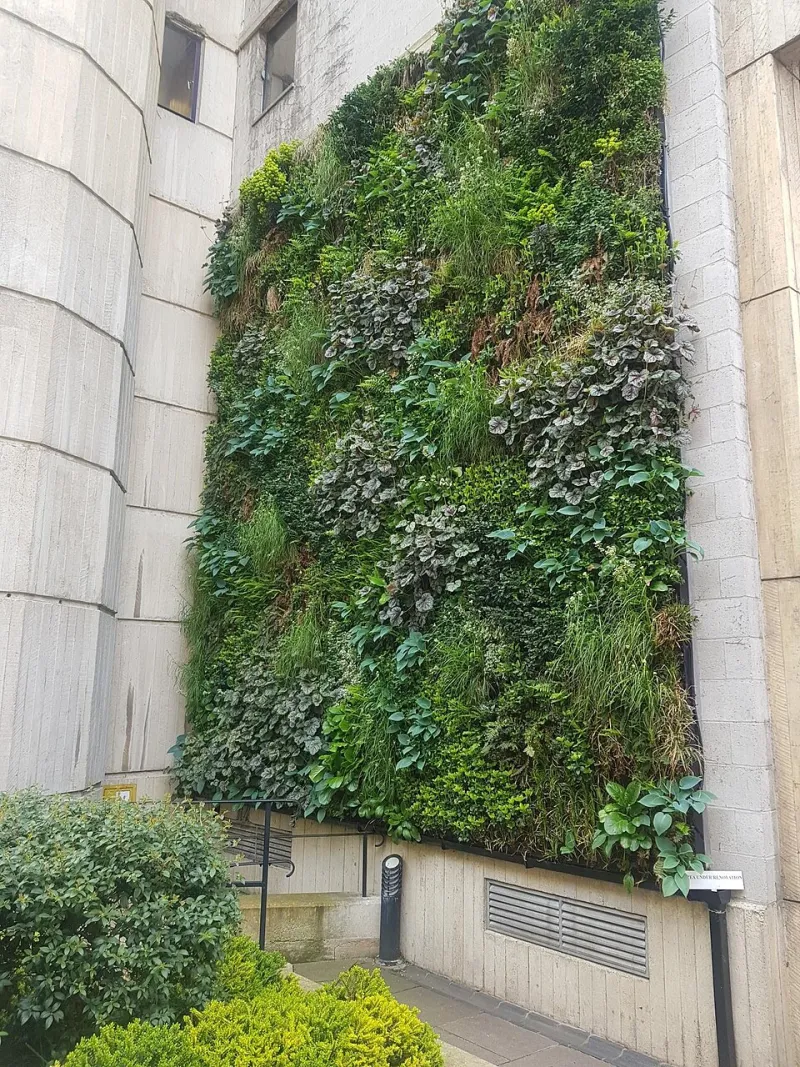
Six months later the wall is a solid mass. Nothing reads. The specimens you paid real money for have disappeared into the crowd. And somewhere in the middle, air isn't moving.
Density is not the same as fullness
A living wall is a composition, and composition is built out of two materials: what's planted and what's left open. The second one is free, and it's the one almost nobody spends.
Open space in a planted wall does actual work. It creates contrast so a single specimen reads as a focal point instead of a texture. It lets light reach lower leaves instead of stopping at the canopy. It gives a wall a top edge and a bottom edge, which is what separates a designed panel from a green rectangle.
The photograph test is brutal and useful: take a picture of the wall from twelve feet back, which is roughly how a buyer or a guest will see it. If the image reads as one flat field of green, the wall is overplanted. If your eye lands somewhere — one plant, one cluster, one line — it's composed.
What overplanting actually costs you in winter
This matters more in Albany than in most places. From December through March, a dense wall is a shaded wall. Interior light drops, growth slows, and the middle of the panel stops transpiring efficiently. Tight spacing traps moisture against leaves and stems, which is exactly the condition leaf spot and root rot are looking for.
Thin it out and airflow improves, light penetrates, and you can actually see the first signs of a problem before it becomes a replacement.
There's a maintenance side too. Pruning a stuffed wall takes twice as long and costs more if someone else is doing it. Every plant you add is a small permanent obligation.
A method for editing, not just planting
Start with sightlines. Stand where people actually stand — the doorway, the couch, the sink — and find the eye-level band, roughly four to six feet off the floor. That band is prime real estate, and it should hold your best material, not the overflow.
Then pick one. One focal specimen, positioned deliberately, ideally slightly off-center. A large-leafed plant with real architecture, a variegated cultivar, a specimen fern that fills a two-foot circle on its own. Everything else supports it.
Next, establish edges. Commit to a clear boundary at the top and sides of the panel. Trailing plants are gorgeous when they're allowed to spill deliberately over one section, and messy when they're spilling everywhere.
Finally, subtract. Pull ten percent of what you'd planned and look at the wall for a week before adding anything back. Most people find they don't want it back.
The listing argument
For anyone selling in the next year or two, restraint is also just better marketing. Overplanted walls photograph as green clutter. They compete with the room instead of giving it a focal point. Slimmer, more sculptural walls photograph cleanly, show the architecture behind them, and read as a designed feature rather than a hobby.
Buyers respond to intention. That's basically the whole game in staging, and a sparse, confident wall signals intention more loudly than a dense one.
Where to spend the savings
Fewer plants means you can afford better ones. Half the count at double the quality per plant produces a wall that looks more expensive, ages better, and asks less of you. Put the money into the focal specimen, into lighting, and into the irrigation components that fail first.
Space is a design material. Use it on purpose.