The Grid Goes Down, the Pumps Go Quiet: A Winter Outage Playbook for Your Green Wall
Photo: Tangopaso, Public domain, via Wikimedia Commons
An ice storm rolls through the Helderbergs, the lines come down along the boulevards, and by evening the house is dark and getting colder. For most houseplants, this is a non-event. For a living wall, it is a countdown.
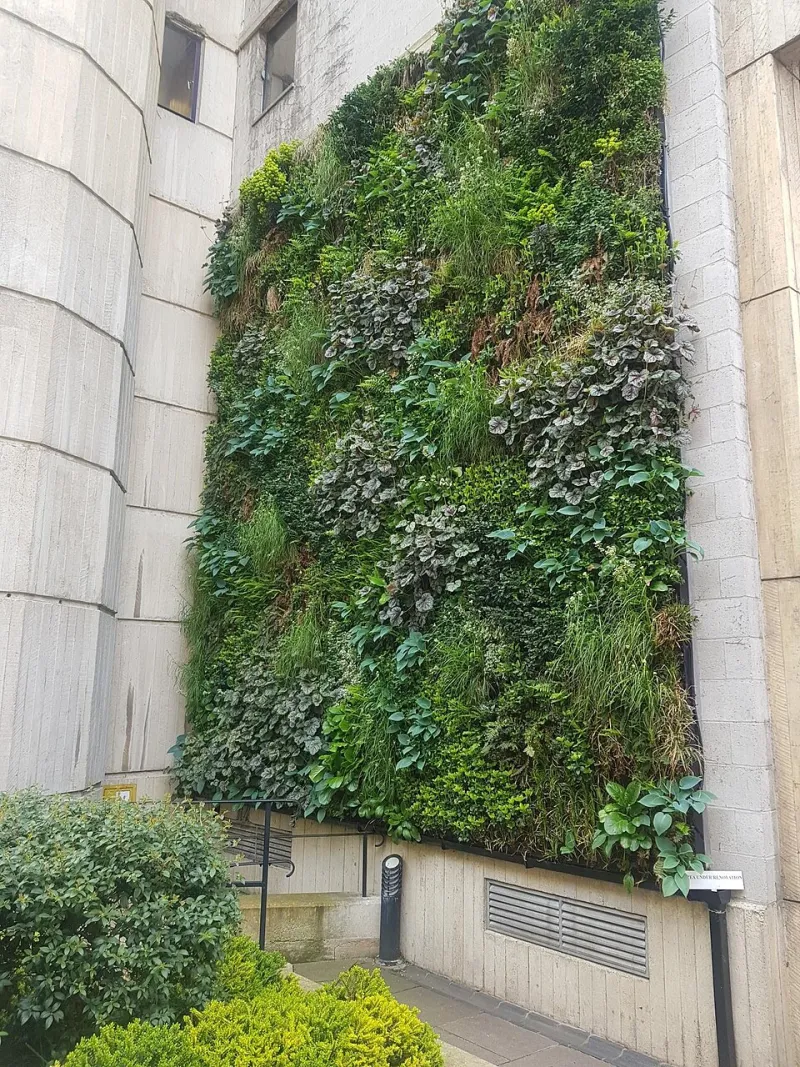
A green wall is not a collection of plants. It is a small machine with plants attached: a pump, a timer, a reservoir, grow lights, sometimes a fan. Every one of those parts assumes a grid that is doing its job. When it stops, the wall does not fail immediately — it fails on a schedule, and the schedule is knowable.
Build the Kit in October, Not During the Storm
Every hardware store in the Capital Region sells out of batteries and jugs within six hours of a warning. Assemble this in autumn and leave it in one labeled bin.
- Two 20,000 mAh USB power banks, kept charged
- A battery or USB aquarium air pump with airline tubing
- USB LED grow strips (the flexible kind, 2 to 3 feet)
- Two spray bottles and a one-gallon hand pump sprayer
- A battery-powered thermometer and hygrometer
- Two 5-gallon water jugs, filled
- A headlamp, plus a printed one-page care sheet for the wall
- Moving blankets or a couple of large cardboard sheets
- A small wet/dry vac or a stack of old towels
- A roll of painter's tape
That is maybe ninety dollars of gear, and it is the difference between losing a few leaves and rebuilding the wall.
Hours 0 to 12: Do Less Than You Think
Counterintuitive but reliable: the best move in the first half day is inaction.
Do not flood the wall. Do not haul every plant into the bathroom for a steam bath. Do not drape blankets over the frame in a dark room — that blocks what little light enters and traps humidity against a cool surface. Close the doors to the room, keep the house sealed, and check the reservoir level with the headlamp.
If the wall is a recirculating system, the growing media holds a surprising amount of water. Twelve hours with the pump off is not a crisis. Root damage in a blackout almost always comes from overwatering, not from dryness.
Hours 12 to 36: Air and Light, Not Water
Roots in a closed system need oxygen more than they need a top-up. Run the battery air pump into the reservoir for ten minutes every two hours. That is enough to keep the water from going stagnant and the roots from suffocating.
Only water if the media is dry to the touch an inch down. With the pump off and the lights off, plants are transpiring very little; pouring water in because the reservoir looks low is how you get root rot in the dark.
Light is the other lever. In daylight, gather everyone in the brightest room and pull curtains wide — a December window in Albany is dim but not nothing. Add USB grow strips for four to six hours, and do not attempt a fourteen-hour photoperiod on battery power. You are trying to prevent decline, not push growth.
Hours 36 to 72: The Decision Point
This is where indoor temperature starts to matter more than anything else. Tropicals begin to sulk below about 55°F. Below 50, the damage becomes structural rather than cosmetic.
If the house is dropping, triage. Move the most valuable or hardest-to-replace plants off the wall and into the smallest room you have, ideally one warmed by a rated indoor-safe heater or simply by people and closed doors. Group them tightly; a cluster holds warmth better than a spread-out collection.
Never bring a camp stove, grill, or kerosene heater indoors. Never run a generator inside a garage or within twenty feet of a window. A carbon monoxide alarm belongs in the kit, and this is the exact scenario it exists for.
Cold tolerance, roughly: pothos, philodendron, and most ferns are the fragile end. Snake plant, spider plant, hoya, fatsia, English ivy, and cast iron plant handle the upper 40s with less complaint. Succulents set into a wall are the first casualties of cold plus damp.
What Actually Dies First
Ranked by frequency in our experience: overwatering in the dark, mold on a cool damp wall assembly, then cold damage, then light deprivation. Notice that light comes last. A wall can go three days without meaningful light and look tired but recoverable. It cannot go three days sitting in water at 48 degrees.
When the Power Returns
Do not restart everything at once. The plants have been through a stress event; a full-blast reset causes its own shock.
Day one: lights on for six hours, one irrigation cycle. Day two: eight hours, two cycles. Day three: back to your normal schedule. Smell the growing media and check the drip tray for standing water before you re-enable the pump. Expect some leaf drop over the following week — that is a stress response, not a verdict.
The Cheapest Insurance You Can Buy
If outages happen more than once a winter, put a small uninterruptible power supply on the pump only. Pump draw on a typical wall is under 15 watts, which means even a modest UPS buys you many hours of circulation — the single most important function in the system. Lights can stay dark. Water movement cannot stop.
Check the batteries in October and again in January. Tape the care sheet inside a cabinet door where a housesitter can find it. And write the triage order on it now, while the lights are on and nobody is worried.