After Dark: Giving Your Living Wall a Lighting Plan, Not Just a Sunlight Plan
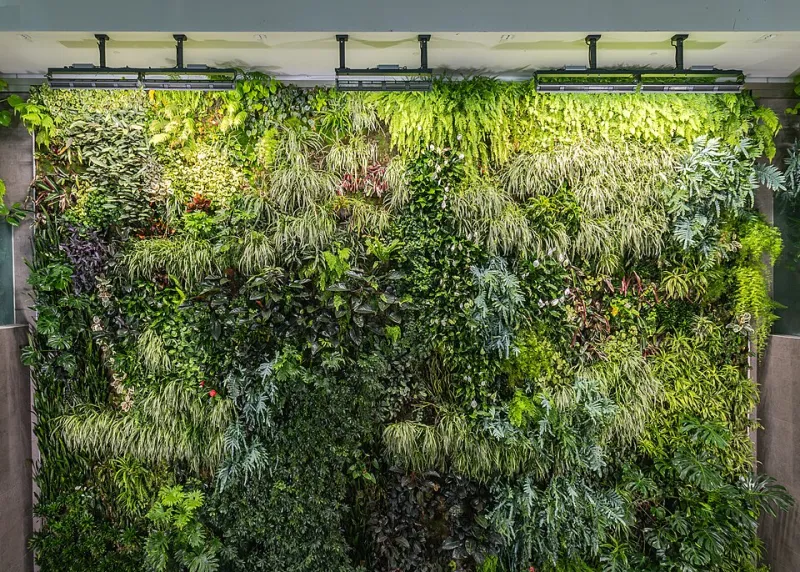
Photo: Chris Woodrich, CC BY-SA 4.0, via Wikimedia Commons
Ask any plant person about their living wall and they'll happily lecture you about windows. South-facing, east-facing, the shadow cast by that neighbor's massive oak — daylight gets all the attention. But here's the thing nobody puts on the mood board: your plants spend roughly half their existence in the dark. And in Albany, where the sun clocks out before 4:30 in December, that dark half stretches longer than most of us realize.
At our studio, we've installed enough green walls around the Capital Region to know that the ones that fail rarely fail because of sunlight. They fail because nobody planned for the night shift.
The Winter Reality Check
From November through March, Albany sits in a stretch of gray that would challenge even the hardiest pothos. Daylight hours shrink to barely nine, and on overcast weeks, the actual usable light for photosynthesis is a fraction of that. Your living wall doesn't hibernate just because you've switched to cozy mode — it's still respiring, still growing (slowly), still burning through its energy reserves.
That's where supplemental lighting comes in. Think of it less as hospital equipment and more as the difference between your plants surviving winter and actually looking good doing it.
Spectrum Talk, Minus the Jargon
Grow lights come in two flavors you'll actually encounter as a homeowner:
Full-spectrum white LEDs look like regular lighting and render your plants in true color. They're our default recommendation for living walls in shared living spaces because they don't scream "greenhouse."
Red-and-blue blended lights are efficient and effective, but they bathe your wall in a purplish glow. Great for a basement plant room, less great for the feature wall behind your sofa.
For most Albany homes we style, full-spectrum LED in the 3000–4000K range hits the sweet spot: plants photosynthesize happily, and the light flatters the rest of the room.
Hiding the Hardware
Here's where the design side earns its keep. Nobody wants their living room to look like a commercial grow operation. A few tricks we use on installs:
- Tuck fixtures into the top reveal of the wall frame, angled down like picture lights. Guests notice the glow, not the fixture.
- Run a slim track or bar across the top, painted to match the wall, so it disappears into the composition.
- Warm-dim capable LEDs let you drop the intensity in the evening, so the wall shifts from "working" to "mood lighting" after dinner.
- Conceal wiring inside the wall structure from day one. Retrofitting cords down a finished wall is the fastest way to ruin the look.
Done right, the lighting reads as intentional design — a warm halo over the greenery — rather than equipment bolted on as an apology.
What Your Plants Need After Sundown
Not all foliage is equally needy. On our installs, we roughly sort species into three tiers:
Low-demand (pothos, philodendron, ZZ plants): happy with 8–10 hours of supplemental light at low intensity. Forgiving of the occasional dark weekend.
Moderate (ferns, fittonia, calathea): want consistent daily light and appreciate a timer more than you'd think. Irregular schedules stress them.
High-demand (flowering varieties, some herbs): need 12+ hours and brighter output. These belong in your sunniest zones or under dedicated fixtures.
The bigger mistake we see isn't too little light — it's too much of the wrong schedule. Plants need darkness too; a wall lit 24/7 shows stress within weeks. A $15 outlet timer solves this permanently.
A Sample Plan: The 6x8 Wall
Let's get concrete. Say you've got a 6-foot-wide, 8-foot-tall living wall in the living room — a common feature-wall size we install around Albany.
Fixtures: Two 48-inch full-spectrum LED bars (about 40W each) mounted in the top reveal, angled to wash the full height of the wall.
Schedule: 6 hours of supplemental light, starting at 3 PM — bridging the gap when Albany's winter sun fades — and shutting off at 9 PM.
Energy math: 80 watts total × 6 hours = 0.48 kWh per day. Over a 150-day heating-and-darkness season, that's roughly 72 kWh. At National Grid's current residential rates (around 25 cents per kWh all-in for our region), you're looking at about $18 for the entire winter. Less than a month of streaming subscriptions, for a wall that stays lush through February.
Add a smart plug for another $20 and you can adjust the schedule from your phone as the days lengthen — dialing hours back in April until the wall weans off entirely by May.
Design the Dark Half on Purpose
The best living walls in the homes we visit aren't the ones with perfect windows. They're the ones where somebody thought about the whole 24-hour cycle — where the light that keeps the plants alive also makes the room feel finished at 7 PM in January.
So when you plan your wall, chart your sunlight, sure. But then design the night shift too. Your plants — and your winter evenings — will thank you.