Design the Wall for December: Building Your Living Wall Around Albany's Shortest Day
The June Trap
There's a pattern we see over and over at Living Walls Albany. A homeowner calls in April or May, energized by the first warm weekend of the season. They pick a statement wall, we install, the wall explodes with growth through the long, generous days of June and July. Everyone's thrilled.
Then late October rolls around. Albany's daylight drops fast — we're at nearly 15 hours of light on the summer solstice and barely 9 by December 21. That's a 40 percent cut in the resource your plants depend on most. By the time the tree in Washington Park is lit for the holidays, the wall that looked effortless in July is thinning out, yellowing at the base, and dropping leaves onto the console table below.
The problem isn't the plants. It's that the wall was designed for the best-case scenario instead of the worst one.
Start With the Darkest Day
Here's the exercise we now run with every client: plan the wall around December 21, not June 21.
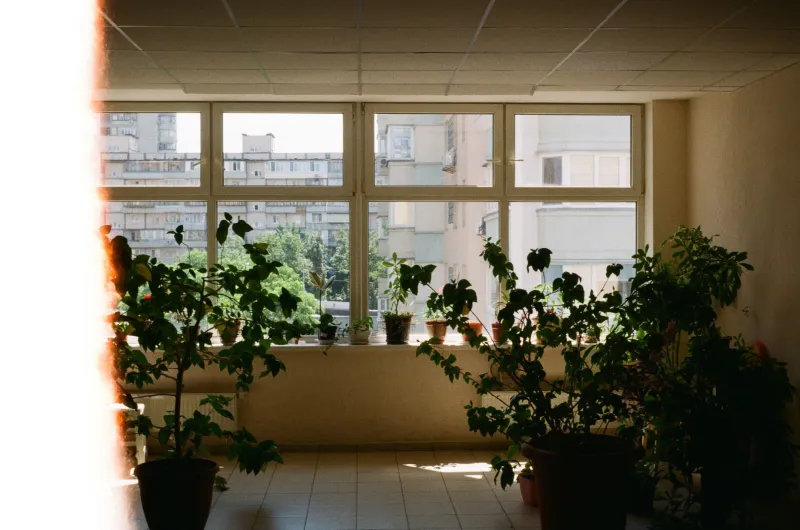
Grab your phone and note where sunlight actually lands in the room at 9 a.m., noon, and 3 p.m. on a short winter day. South-facing windows will still throw meaningful light across the floor. East- and west-facing rooms get a couple of weak hours each. North-facing walls — which often look fine in summer — may go essentially dark for months.
If your candidate wall doesn't receive at least a few hours of usable light on the shortest day of the year, it's not a no-go. It just means the design needs a lighting layer from day one, built in rather than bolted on later.
Grow Lights That Don't Look Like Grow Lights
The old approach was a clamp lamp with a purple bulb — functional, sure, but it made your living room look like a commercial hydroponics operation. Nobody wants that during the holidays when the whole extended family is visiting.
The good news is that modern full-spectrum LED fixtures have solved most of this. A few approaches that read as design choices rather than supplements:
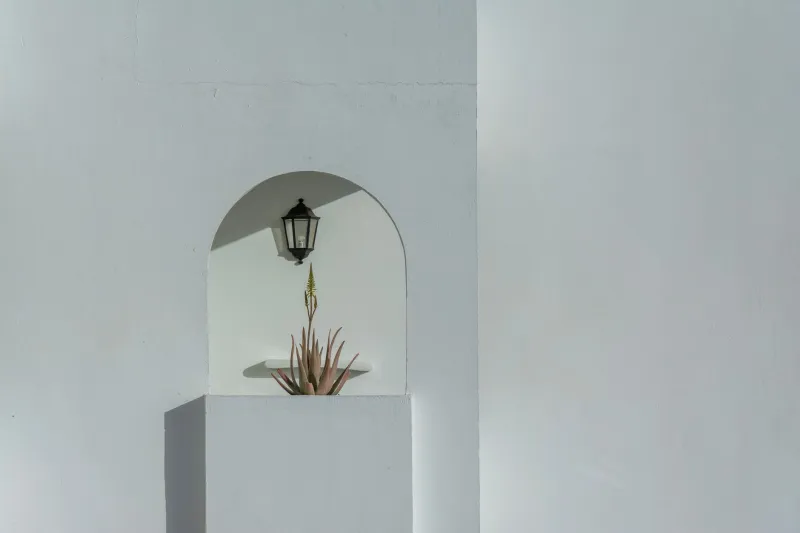
- Picture lights. A slim brass or matte-black picture light mounted above a section of the wall is a classic gallery move. It flatters the foliage and delivers serious photons from about 18 inches away.
- Track and spot lighting. A two- or three-head track in a warm finish, aimed at the wall's canopy, doubles as ambient evening lighting for the whole room.
- Integrated linear strips. Tucked along the top edge of the wall or beneath a floating shelf, a warm-white LED strip washes light down the foliage the way a wall sconce washes a textured wall.
- Recessed downlights. If you're already renovating, a pair of cans on a dimmer aimed at the wall gives you total control — bright for the plants, dialed down for movie night.
The key phrase is warm white. You want fixtures in the 3000–4000K range. Your plants don't care about the difference between that and a 6500K blue-white grow bulb nearly as much as your eyes do.
Layering Natural and Artificial
Think of your wall's lighting the way you'd think about lighting a room: ambient, task, and accent.
In summer, the window does the heavy lifting and your fixtures are accent. In winter, the roles reverse — the fixtures become the primary light source, and the window is a bonus. If your grow lights are on a smart plug or a simple mechanical timer, you can automate this. Set them for a 12-hour window (say, 8 a.m. to 8 p.m.) from November through March, then dial the schedule back as the days lengthen.
One practical tip: put the lights on a dimmer or use dimmable fixtures if you can. Foliage walls are forgiving, but a wall that runs at full brightness in a dark living room at 7 p.m. can feel like an airport lounge. Dimming to 60 or 70 percent in the evening keeps the plants happy and the room cozy.
A Note on Placement
Light placement matters as much as fixture choice. Foliage thins where light doesn't reach, so aim fixtures to cover the full face of the wall, not just the top. If your wall is taller than about six feet, plan for at least two light sources so the lower plantings don't fade out by February.
And check the fixtures against your wall's irrigation. Electrical and water both live behind or beside a living wall — plan them together during the design phase, not as an afterthought in November.
The Payoff
A wall designed for December doesn't just survive winter — it becomes part of how the room works in winter. When it's dark at 4:30 p.m. and there's a foot of snow in the driveway, a glowing, green, softly lit wall is doing more for your mood than any houseplant on a windowsill ever could.
Design for the darkest day, and every other day of the year takes care of itself.