Before You Mount That Wall of Green, Meet the Shadow Problem
Every living wall we install in Albany comes with a promise: more life, more texture, more calm. What we don't always mention at the consultation — and probably should — is that a wall of plants is also a wall of shadows.
It's not a flaw. It's physics. But if you've ever installed a dense foliage feature and wondered why your reading chair suddenly feels gloomy at 4 p.m., this one's for you.
Where the Light Actually Goes
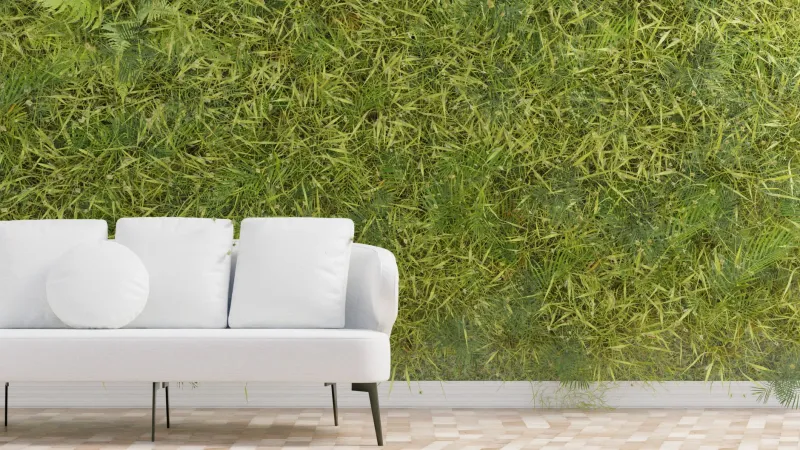
A living wall is, functionally, a soft black hole for illumination. Leaves absorb and scatter light, and a dense planting panel can swallow 30 to 50 percent of the daylight that would otherwise bounce off a painted wall and back into the room.
The effects show up in sneaky ways:
- Dappled patterns on the floor. Beautiful at noon, slightly moody by 3 p.m. in December, when the sun in upstate New York is already hanging low.
- A dimmer zone in front of the wall. Furniture pulled up within three or four feet of a dense planting often needs its own lamp sooner than the rest of the room.
- Cooler color temperature overall. Green foliage reads as a darker, cooler surface than cream paint or white oak, which shifts the whole room's feel even when the light level hasn't technically changed much.
None of this means living walls and bright rooms are enemies. It means the wall needs a lighting plan, just like it needs a watering plan.
The Three-Layer Lighting Fix
When we design a green wall for a client — whether it's a Capitol Hill brownstone or a modest Delaware Avenue ranch — we build the lighting in three layers, and you can steal the approach for your own home.
Layer one: wash the wall itself. A slim LED track or picture light mounted above or below the planting does double duty. It keeps the plants healthy and pushes light back into the room, turning the wall from a light absorber into a soft, glowing backdrop. Aim for a warm tone, around 3000K, so the green doesn't go clinical.
Layer two: bounce light off the ceiling. Uplights placed a few feet in front of the wall throw illumination upward, filling the shadow pocket that forms in front of dense foliage. Even a pair of inexpensive floor-can uplights can erase that gloomy zone entirely.
Layer three: task light where people actually sit. If your sofa or reading chair faces the wall, give it a lamp with a shade that throws light sideways and down. Don't rely on the room's overhead fixture to fight the foliage on its own — it will lose.
Choose Surfaces That Fight Back
Lighting is half the battle. The other half is what the light hits after it leaves the lamp.
We steer clients toward reflective and light-friendly finishes near any large installation: a matte-but-pale oak floor, a glass or brass coffee table, a mirror positioned perpendicular to the wall so it catches and rethrows the greenery itself. (We've written before about mirrors rescuing dark-corner walls — the same principle applies here, just in reverse.)
One more trick from our staging work: keep the wall color adjacent to the planting light. A pale sage or warm white beside a green wall makes the foliage pop while refusing to let the room sink into shadow.
A Quick Winter Reality Check for Albany
From November through March, our daylight hours shrink to a sliver, and a light-hungry green wall becomes even hungrier. If your installation sits near a south- or west-facing window, you're in decent shape. If not, plan on running your grow-and-glow lighting on a timer for eight to ten hours a day through the dark months. Your plants will thank you, and so will your winter-weary eyes.
The Payoff
Handled well, the shadow side of a living wall becomes a feature, not a bug. That soft, filtered light is part of why planted rooms photograph so beautifully and why staged homes with greenery tend to linger in buyers' memories. You just have to design for the darkness the same way you designed for the green.
Measure your wall, map your light, layer your lamps. The room stays bright, the plants stay lush, and nobody has to choose between the two.