Green Walls, Quiet Rooms: What Happens When Foliage Meets a Shared Wall
The Party Wall Problem
If you've ever lived in one of Albany's classic brownstones or a converted row house off Lark Street, you know the soundtrack: muffled conversations through the plaster, a neighbor's TV bleeding through at 11 p.m., the bass line of somebody's Saturday night. Shared walls are the tax you pay for character housing.
So when a client on Myrtle Avenue asked whether a living wall could actually quiet things down, we didn't want to guess. We wanted numbers.
The Experiment: One Wall, Two Readings
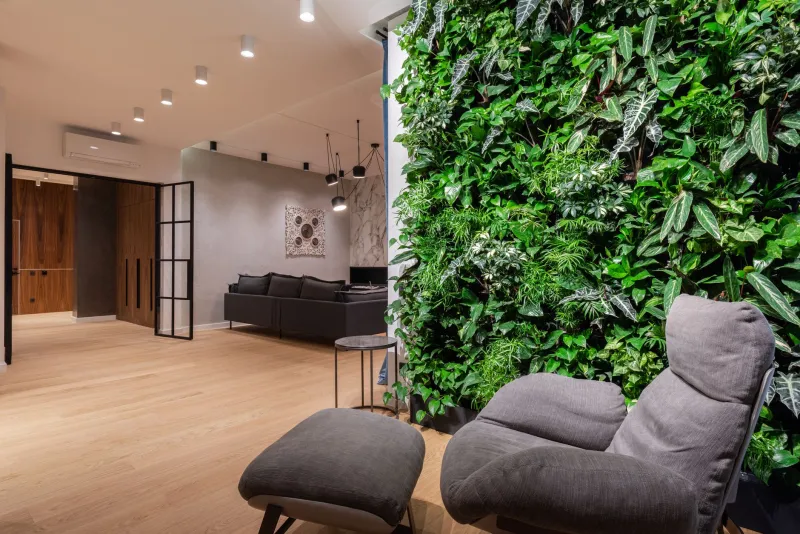
We partnered with an acoustics consultant and a homeowner in a Pine Hills duplex to run a simple before-and-after test. Using a calibrated decibel meter placed at ear height, three feet from the shared wall, we recorded ambient sound over two evenings — once with the bare plaster wall, and again three weeks after installing a planted panel of pothos, philodendron, and ferns.
The baseline? An average of 52 decibels during peak evening noise, with distinct spikes when the neighbors' television ran dialogue-heavy scenes.
After the install, the average dropped roughly 3 decibels. Not silence — but noticeable.
What the Expert Said
Our consultant was quick to add context. "Plants aren't soundproofing," he told us. "A true acoustic barrier needs mass — drywall, mass-loaded vinyl, that kind of thing. But vegetation does something different. The leaves scatter and absorb high-frequency sound, which is exactly the range where voices, clicks, and TV chatter live."
In other words, a living wall won't block the thump of a subwoofer. But it can take the edge off the higher-pitched noise that makes a room feel busy — and, just as importantly, it changes how a room sounds from the inside.
Why It Works: The Science, Briefly
Sound behaves like water hitting a bush. Hard, flat surfaces — plaster, drywall, glass — reflect sound waves back into the room, creating that slightly hollow, echoey quality. A planted wall introduces irregular, soft surfaces at many angles. Leaves flex and absorb energy; the growing medium behind the panels adds a layer of porous material that soaks up mid-range frequencies.
The result is twofold:
- Less incoming noise — a modest reduction, typically 2–5 decibels depending on density and coverage
- Less echo inside — often the more dramatic effect, making the room feel calmer and quieter even when the neighbors haven't changed a thing
The Staging Angle: Quiet Sells
Here's where this matters beyond comfort. If you're preparing an Albany home for sale — especially a condo, duplex, or anything with shared walls — how a room feels during a showing is everything. A living wall on a party wall does three things for a listing:
- It softens acoustics, so the space feels hushed and considered rather than boxy and live
- It signals care and design intention, which buyers read as maintenance and pride of ownership
- It photographs beautifully, adding depth and color to listing shots that might otherwise be flat
We've seen buyers linger longer in rooms that feel acoustically calm, even if they can't articulate why. That extra thirty seconds in a room matters.
Managing Expectations
We'll be honest, because that's how we do things here: if your neighbor runs a drum kit against your shared wall, no amount of greenery will save you. Call a contractor about insulation and resilient channels first.
But for the everyday hum of apartment life — voices, footsteps, the general buzz of a dense neighborhood — a living wall is a legitimate piece of the puzzle. It's not a substitute for soundproofing; it's a complement. One that also cleans your air, looks stunning, and might just make your living room the favorite room in the house.
On Myrtle Avenue, the homeowner's verdict was simpler than any decibel reading: "It feels like the wall stopped talking back."
Sometimes that's the whole point.